✍️ Written by the Healthy Living Hub team — for women over 40 who want real answers about movement and health.
🔬 Checked against: research from JAMA Internal Medicine, the British Journal of Sports Medicine, and Harvard Medical School.
🕒 Last updated: August 2026 | Reading time: ~6 minutes
Every night, I used to look at my phone before bed and check one number: my step count. If it wasn’t 10,000, I felt like I’d failed. Even on days I chased my kid around the yard, hauled laundry up two flights of stairs, and stood in line at the grocery store for 20 minutes. None of that counted, apparently. Only the number on the screen mattered.
Then my knee started acting up. My physical therapist asked why I was so set on 10,000 steps a day. I didn’t have a good answer — it was just “the number.” That question sent me down a rabbit hole. What I found changed how I think about walking completely.
🔍 Where Did “10,000 Steps” Even Come From?

Here’s the surprising part: no doctor or scientist ever said you need 10,000 steps a day. The number comes from a pedometer that went on sale in Japan in 1965. It was called the “10,000-step meter,” and the number was chosen because it looked catchy on the box — not because of any health study.
That marketing slogan somehow stuck around for 60 years. It made its way into fitness watches, phone apps, and workplace wellness programs. Most of us never questioned it. I know I didn’t.
Finding this out didn’t make me want to stop walking. But it did make me stop treating a made-up number like a doctor’s order.
📊 What Does the Research Actually Say?

This is the good news part. Real studies have looked at step counts in women over 40 — and none of them point to 10,000 as a magic number.
- One large study followed over 16,000 women in their 70s for several years. Women who walked about 4,400 steps a day had a much lower risk of dying early than women who walked around 2,700 steps a day. [1]
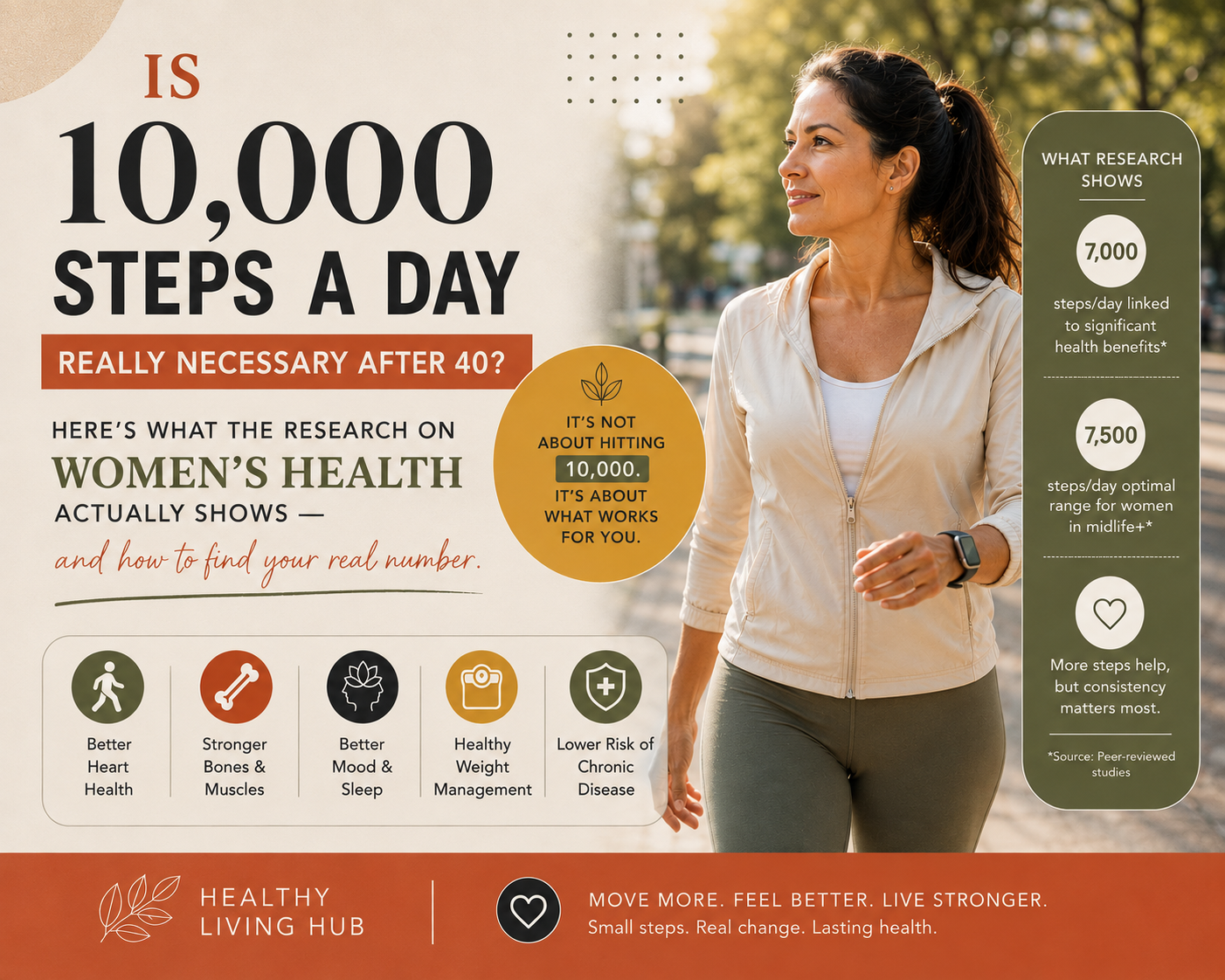
- The benefits kept growing as women walked more — but they leveled off around 7,500 steps. Walking more than that didn’t add much extra benefit. [1]
- A newer study found that even walking 4,000 steps just once or twice a week helped lower the risk of early death and heart disease in older women. More often was even better, but you didn’t need to do it every day to see results. [2]
- Other researchers confirmed the same thing I found: the 10,000-step number came from a 1960s ad campaign, not a lab. [3]
In simple terms: your body starts benefiting from walking long before you hit five figures on your tracker. Going from barely moving to walking regularly matters far more than squeezing out those last 2,000 steps.
🌱 Why Less Might Actually Be Better After 40
This doesn’t mean walking stops mattering after 40. It means the goal should fit your body now, not the body you had at 25.
Your body needs more recovery time. As hormones shift during perimenopause and menopause, joints and muscles often take longer to bounce back. I’ve heard from so many women in this community who pushed for a big step count every single day and ended up with sore knees or achy feet instead of feeling stronger.
Showing up regularly beats a perfect number. A woman who walks 5,000 to 7,000 steps most days, and does two strength workouts a week, is likely doing more for her health than someone who forces 10,000 steps on Monday and can’t move on Wednesday.
How you walk matters, not just how far. A brisk 20-minute walk up a hill can do more for your heart than a slow 45-minute stroll on flat ground — even though the slow walk racks up more steps.
Your joints get a vote. If your knees, hips, or back already bother you, forcing a strict number can push you into pain instead of progress. It’s okay to build up slowly.
⚖️ So — Myth or Helpful Habit?
Honestly, it’s a little of both.
The myth part: 10,000 steps was never based on science. Treating it like a strict rule can leave you feeling guilty for no good reason, or even push you toward injury.
The helpful part: walking itself is still one of the best things you can do for your heart, your bones, your mood, and healthy aging. The habit is good. The number just needed an update.
🎯 How to Find Your Own Number

Instead of asking “did I hit 10,000 today?”, try asking these instead:
- 📱 What’s normal for me right now? Check your steps for a week without trying to change anything. That’s your real starting point — not someone else’s.
- ➕ Can I add a little more each week? Try adding 500 to 1,000 steps a week instead of jumping straight to a big number. Small steps (literally) are easier on your joints.
- ⚡ Am I picking up the pace sometimes? A short walk up a hill, a set of stairs, or a few minutes of faster walking can matter more than extra slow, flat steps.
- 🏋️♀️ Am I also doing some strength work? Walking is great for your heart. Your bones and muscles need lifting or resistance work too — especially after 40.
- 😊 How do I feel the next day? A little tired is normal. Sharp pain or feeling wiped out for days is your body asking you to ease up.
🏡 Making Walking Fit Into a Busy Life

Most of us aren’t walking on a quiet treadmill with nothing else to do. We’re squeezing it in around work, kids, and everything else. A few things that actually help:
- 📞 Add it to things you already do. Take a phone call while walking around the block. Park at the far end of the lot. Take the stairs instead of the elevator. It adds up without needing a spare hour.
- 🛒 Count the steps you don’t “plan.” Grocery shopping, chasing your kids around the park, cleaning the house — that’s real movement too, even if it doesn’t feel like a workout.
- 📅 Set a goal that fits your week. Aiming for 6,000 steps during a crazy work week is more realistic — and healthier — than forcing 10,000 and giving up on the whole habit by Thursday.
- 🔄 Check back in every few months. As you get stronger, or life gets busier, your number will change. That’s not failure. That’s the habit working the way it should.
Key Takeaways
🚶♀️ 10,000 steps came from a 1965 ad, not a doctor. A Japanese pedometer company picked the number because it looked good on the box.
📉 You don’t need that many steps to feel the benefits. Research shows real gains starting around 4,000 to 4,400 steps a day, leveling off around 7,500.
❤️ Showing up matters more than the exact number. A shorter, brisker walk most days beats a long walk you only do once in a while.
🦴 Pair walking with strength training. Walking helps your heart. Lifting or resistance work protects your bones and muscles, which matters more after 40.
🩹 Listen to your joints. Forcing a number that causes pain does more harm than good.
🎯 Your “right” number is personal. Start with where you are now, add a little at a time, and adjust as life changes.
❓ Frequently Asked Questions
Is 10,000 steps still a good goal for women over 40?
It can be, if it feels good and doesn’t cause pain. But it’s not required. Research shows real health benefits well below that number, so a lower, steady goal often works just as well.
How many steps should I aim for after 40?
Most research points to real benefits starting around 4,000 to 7,500 steps a day. Your best number depends on your fitness level, your joints, and your daily life.
Will walking alone help with weight gain during menopause?
Walking helps your heart and can support weight management, but adding strength training tends to work better for the muscle and bone changes that come with this stage of life.
What if I only manage 3,000 to 4,000 steps a day right now?
That’s a solid starting point. Studies show a real drop in health risks even at that level compared to barely moving at all. Progress matters more than a perfect number.
📚 Sources & Further Reading
1. Lee I-M, et al. “Association of Step Volume and Intensity With All-Cause Mortality in Older Women.” JAMA Internal Medicine, 2019. pmc.ncbi.nlm.nih.gov/articles/PMC6547157
2. Hamaya R, et al. Step count frequency and cardiovascular/mortality risk in older women, British Journal of Sports Medicine, covered by Harvard Gazette, 2025. news.harvard.edu/gazette
3. University of Tennessee coverage of Dr. I-Min Lee’s (Harvard Medical School) research on the origins of the 10,000-step figure. accolades.utk.edu
⚠️ Disclaimer: This article is for general educational and informational purposes only and is not a substitute for professional medical advice, diagnosis, or treatment. Always talk with your doctor or a qualified healthcare provider before starting or changing an exercise routine, especially if you have joint issues, cardiovascular concerns, or other health conditions. The personal experiences shared here reflect individual perspectives and may not apply to everyone. Sources cited above are provided for transparency; always refer to the original studies for full context and methodology.
Leave a Reply