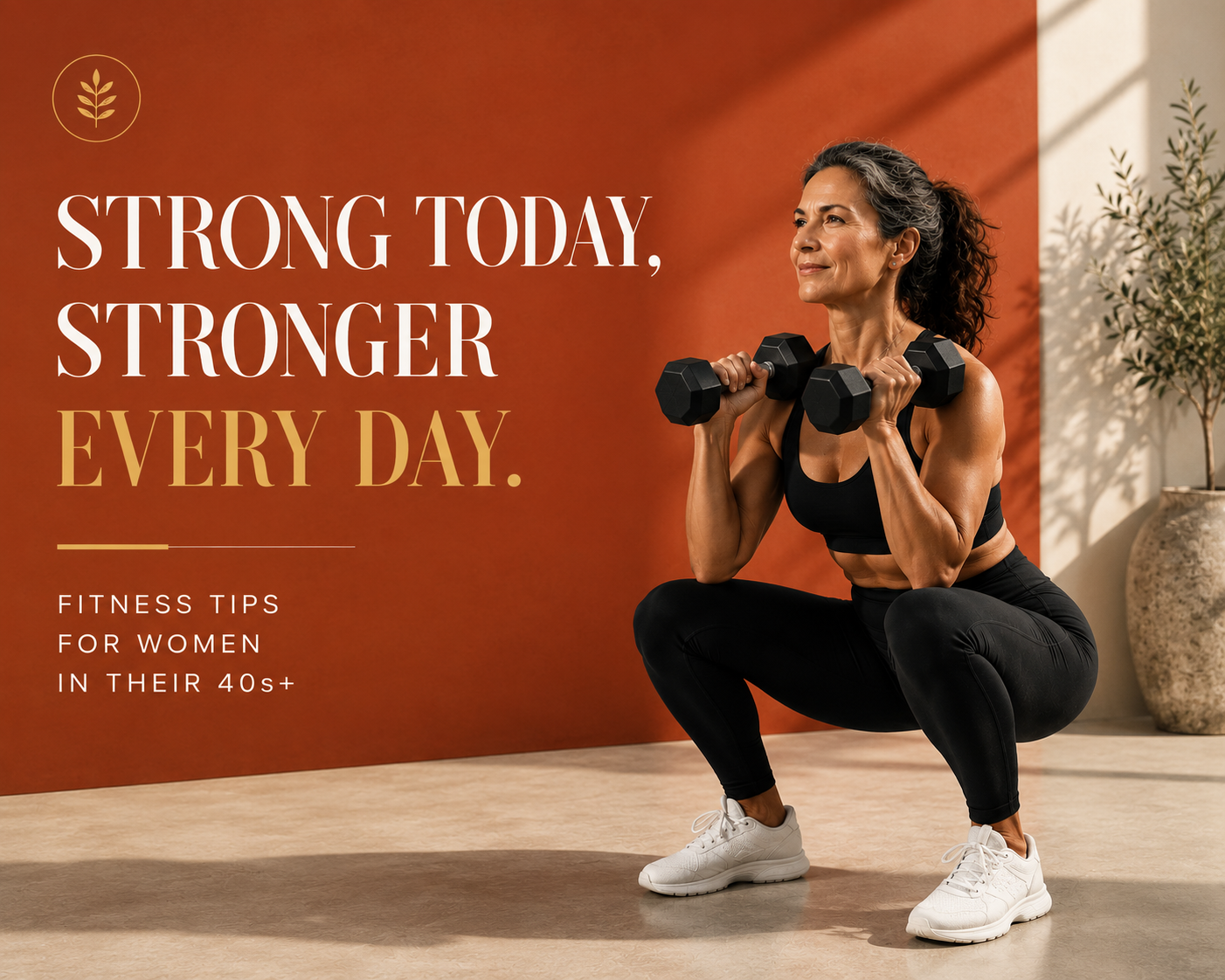
I’ll be honest — the year I turned 40, I panicked a little.
Not in a dramatic way. More like, I stood in front of my closet one Tuesday morning, couldn’t find anything that fit quite right, and thought, okay, time to “fix” this. So I did what a lot of us do. I googled “how to lose weight after 40” at 11pm, found a 14-day detox plan with a green juice recipe I still remember hating, and started the next morning.
I lasted nine days. Then a work trip happened, the juice went bad in the fridge, and I quietly gave up and felt terrible about it — not because the diet failed, but because I assumed I had.
I tried a few more versions of that over the next year. A no-carb month. An app that made me log every almond. A fitness challenge with a spreadsheet I filled out for exactly six days. Every single one worked for about two weeks and then fell apart the second real life showed up — a sick kid, a busy week at work, a birthday dinner I wasn’t going to skip.
It took me longer than I’d like to admit to realize the problem wasn’t my willpower. It was that I was using a playbook built for 25-year-olds on a body that wasn’t 25 anymore. Once I stopped trying to out-discipline my way through it and actually looked at what works for this decade of life, things got a lot simpler — and a lot more sustainable. So this is the post I wish someone had handed me that Tuesday morning instead of a juice cleanse.
Why Losing Weight After 40 Feels Different( The Science)
I’m not a doctor, so I’ll keep this part short and stick to what’s actually backed up by research (and what my own trainer explained to me when I finally hired one, which — more on that in a minute).
Your muscle mass starts quietly declining from your 30s onward, and that decline picks up pace after 40 if you’re not doing anything to counter it. Less muscle means your body burns fewer calories just existing, which is a big reason the exact same eating habits that worked fine at 32 suddenly don’t add up the same way at 42. It’s not that anything broke. It’s that the math changed.
Then there’s the hormone piece — for women, perimenopause can quietly start years before you’d expect, and it messes with sleep, energy, and where your body decides to store fat. For men, testosterone is on a slow decline too. And recovery? It just takes longer. I used to bounce back from a hard workout by the next morning. Now if I overdo it, I’m feeling it on day three.
None of that is a crisis. It just means the old strategy — eat less, move more, repeat — stops being the whole answer.
Strength Trainning Over 40: The Shift That Changed Everything

I avoided weights for years. I don’t totally know why — I think I had this idea that lifting was for gym people, and I was a cardio person, whatever that means. I did classes, I ran a little, I did a lot of “toning” workouts with two-pound dumbbells that, looking back, weren’t doing much of anything.
Then a friend dragged me to a strength session, and within about six weeks I noticed something I didn’t expect — my back stopped hurting after long days at my desk. Turns out that had a lot more to do with weak muscles than “just getting older,” which is what I’d assumed.
Here’s what I’ve learned works, without needing to become a gym person:
- Two or three sessions a week is genuinely enough. I do full-body strength training on Mondays, Wednesdays, and sometimes Saturdays. 30 to 45 minutes. That’s it.
- The boring compound moves matter most — squats, rows, presses, some version of a deadlift. They work more muscle in less time than anything fancy.
- You don’t need a gym. I did bodyweight squats and resistance bands in my living room for the first four months because gym childcare hours never lined up with my schedule.
- Small, steady increases beat going hard once. I’d rather add a little weight every couple of weeks than have one brutal session that leaves me useless for a week.
If you’ve never lifted before, I’d genuinely recommend one or two sessions with a trainer just for form. I skipped this and tweaked my lower back doing a deadlift wrong. Learn from me.
Zone 2 Cardio After 40: Ditching High Impact Workouts

I used to think a “good” workout meant I finished it dying a little. Turns out that’s not actually the goal, and it was probably part of why my knees started complaining.
What’s replaced the punishing HIIT classes in my week is something called Zone 2 cardio — basically, movement steady enough that you could still hold a conversation, but you’re definitely working. A brisk walk. An easy bike ride. For me it’s usually a 35-minute walk around my neighborhood, sometimes with a podcast, sometimes with my kid on a scooter next to me refusing to keep pace.
It sounds too easy to count as “real” exercise, which is exactly what I thought at first. But done consistently, it builds actual fitness without leaving my joints wrecked — and it’s become one of the more talked-about shifts in fitness for our age group heading into this year, for good reason.
My rule now: if I can’t talk while doing it, that’s a once-or-twice-a-week thing, not a daily one.
Prioritizing Protein Over Strict Diets

This is the part that took me the longest to unlearn. Every diet I’d tried was built around cutting something — carbs, fat, whole meals, entire windows of the day. And every time, I’d end up exhausted, a little obsessed with food, and eventually right back where I started.
What’s actually worked, long term, is almost the opposite:
- I put protein on my plate first, now, at every meal — eggs, dal, paneer, chicken, yogurt — instead of just at dinner like I used to.
- I stopped fearing carbs and fat. Rice, fruit, ghee — they’re back, and honestly my energy is better for it.Swapping out refined wheat for nutrient-dense whole grains is one of the easiest food upgrades you can make. If you want to experiment in the kitchen, check out my guide on 5 Everyday Gluten-Free Flours and How to Cook With Them.”
- I pay more attention to fiber than I used to — it’s not glamorous, but it’s made a real difference for digestion and steady energy through the day.
- I make sure I’m actually eating enough. I used to think under-eating was the “safe” default. It wasn’t — it just made me tired and, weirdly, made it harder to build any muscle at all.
If you want one place to start: put a protein source and a vegetable on your plate before anything else. That’s it. That’s the whole hack.
Sleep Is Doing More Work Than My Workouts Are

I resisted this one for a long time because it felt like a cop-out — “just sleep more” sounded like the fitness equivalent of “have you tried yoga.” But it turns out poor sleep raises cortisol, and cortisol makes it harder to build muscle and easier to hold onto stress weight, no matter how good your gym sessions are.
I’m not someone who meditates for twenty minutes a day. What I actually do is ten minutes of slow breathing before bed — Anulom Vilom, if you want the name for it — and I try to keep my phone out of the bedroom, which I fail at about 40% of the time, if I’m being honest. Even that much has made a noticeable difference in how I feel the next day.
What My Actual Week Looks Like
Not the idealized version. The real one.
- Strength training, 3x a week, 30–45 minutes
- Walks most days, longer ones on weekends
- One tougher workout if I’m feeling good that week — skipped entirely if I’m not
- Protein at every meal, nothing off-limits
- Ten minutes of breathing before bed, most nights
Some weeks I hit all of it. Last week I got two walks and one strength session in around a sick kid and a deadline, and that was still a fine week. That’s the actual point — this isn’t a 12-week program with an end date. It’s just what I do now.
FAQs
Do I need to eat less as I get older to avoid weight gain?
Not necessarily — and in my experience, under-eating backfires. It tends to accelerate muscle loss and raise stress hormones. Focus on protein and food quality before you touch quantity.
Is walking really enough exercise after 40?
Walking is genuinely great for your heart and your head, but pair it with strength training a couple times a week — walking alone won’t protect your muscle mass the way lifting does.
How long before I see results from strength training after 40?
For me it was about six weeks before I noticed real changes — better energy, less back pain. Visible strength changes tend to show up around 8–12 weeks of consistency.
Can I still lose weight after 40 without a strict diet?
Yes. What’s worked for me and for most people I know isn’t restriction — it’s protein, strength training, sleep, and just showing up consistently.
If You Only Do One Thing
Skip the 14-day plan. Pick one thing from this list — strength training, a daily walk, protein at breakfast, ten minutes of breathing before bed — and just do that one thing for the next two weeks. That’s genuinely how I started, and four years later, I’m still doing some version of it.
What’s the one you’re going to try first?
This post is for general educational purposes and isn’t a substitute for personalized advice from a doctor or registered dietitian, especially if you have existing health conditions.
Leave a Reply